

How Do Apps Use Light Detection Technology?
Have you ever wondered how your phone knows exactly where to place that virtual sofa in your living room or how it can measure the length of a wall just by pointing the camera at it? Light detection technology sits quietly inside millions of phones, doing work that would have seemed like science fiction just a few years back (still feels a bit unreal when I explain it to clients). The sensors in modern phones can now shoot out invisible light beams, measure how long they take to bounce back, and use that information to understand the shape and size of the world around them... something we've been building apps around for the past few years with some pretty interesting results.
Light detection sensors have opened up possibilities in mobile apps that were once only available with expensive specialist equipment, making 3D scanning accessible to anyone with a decent smartphone.
The technical term you'll hear thrown around is LiDAR, which stands for Light Detection and Ranging, though several other types of depth sensing technology work in slightly different ways to achieve similar results. I remember when the first phones with proper depth sensors started appearing, everyone got excited about the possibilities, but it took a while for developers to figure out what to actually do with them (learned that the hard way with a few early projects). Now we're seeing these sensors used in everything from interior design apps to games that understand the layout of your room, and the applications keep growing as more phones include the technology.
What Light Detection Means for Your Phone
When we talk about light detection in phones, we're really talking about the ability to measure depth and create three-dimensional maps of physical spaces. Your phone's camera can already see the world in two dimensions, capturing flat images of whatever you point it at, but depth sensing adds that third dimension by figuring out how far away different objects are from the lens. This happens incredibly quickly, sort of like taking thousands of tiny measurements every second to build up a complete picture of the space.
The difference is noticeable.
Different manufacturers approach this in different ways, with some using dedicated LiDAR sensors and others relying on combinations of multiple cameras, infrared dots, or time-of-flight sensors. The end result is roughly the same though... your phone gains spatial awareness and can understand the geometry of the environment it's looking at. We've built apps that use this technology for everything from measuring rooms for renovations to placing virtual objects in real spaces, and the accuracy has improved massively over the past few device generations. However, as with any sensor-based technology, positioning accuracy can be affected by various environmental factors that developers need to consider.
- Phones can now create detailed 3D maps of rooms in seconds
- Depth information helps cameras take better portraits with background blur
- Apps can measure distances accurately without any physical tools
- Virtual objects can interact realistically with physical spaces
- Games can adapt to the actual layout of your room
The Sensors That Make It Work
The actual hardware doing this work comes in a few different forms, depending on which phone you're using. LiDAR sensors work by sending out pulses of infrared light and measuring how long they take to bounce back from objects in the environment (the light travels so fast that we're measuring in nanoseconds here). Time-of-flight sensors use a similar principle but with slightly different technology, whilst some phones use structured light that projects a pattern of dots onto the scene and analyses how that pattern gets distorted by the shapes it hits.
Takes some processing power.
I've worked with all these different sensor types over the years, and each has strengths and weaknesses depending on what you're trying to achieve. LiDAR tends to work better at longer distances and in darker conditions, making it great for room scanning and outdoor augmented reality. Structured light systems can be more accurate at close range but struggle outdoors in bright sunlight. Some phones combine multiple depth sensing technologies to get the best of both worlds, which gives us app developers more flexibility in what we can build. When implementing these features, it's crucial to understand why speed matters more than flashy features in user experience design.
Check your phone's specifications before investing time in depth-sensing apps, as not all devices include these sensors and the quality varies significantly between models and price points.
Measuring Distance With Invisible Light
The physics behind how these sensors work is actually quite straightforward, even if the engineering required to miniaturise it into a phone is pretty impressive. When your phone sends out a pulse of infrared light (invisible to human eyes), that light travels at a known speed... roughly 300,000 kilometres per second, same as all light. By measuring the tiny fraction of time it takes for that light to bounce off an object and return to the sensor, the phone can calculate the exact distance to that object using some basic maths.
Happens millions of times per second.
The sensor doesn't just send out one beam though, it creates a grid of beams that sweep across the scene, measuring the distance to hundreds or thousands of different points. The phone's processor takes all these individual distance measurements and stitches them together into what's called a depth map, which is like a regular image but instead of colours, each pixel contains information about how far away that part of the scene is. We use these depth maps in our apps to understand the three-dimensional structure of whatever the camera is looking at. When adding these demanding features to apps, proper feature testing and validation becomes essential to ensure they work reliably across different devices.
| Sensor Type | Best Range | Main Uses |
|---|---|---|
| LiDAR | Up to 5 metres | Room scanning, outdoor AR |
| Time-of-Flight | Up to 3 metres | Portrait mode, gesture control |
| Structured Light | Up to 1 metre | Face scanning, close-up AR |
Apps That Use Light to Build 3D Models
One of the most practical uses we've seen for depth sensing is in apps that create three-dimensional models of real objects and spaces. Walk around a room with your phone and the app can capture not just photos but the actual dimensions and layout, creating a digital twin that can be measured, shared, or used for planning purposes. I've built several of these for clients in property and construction, where being able to scan a space quickly saves hours of manual measuring with tape measures and laser distance finders. The integration of these scanning capabilities has become particularly valuable in real estate app design where virtual property tours are now expected features.
The accuracy is impressive.
These 3D scanning apps work by combining the depth information from the sensors with the visual data from the regular camera, tracking how the phone moves through space and stitching together multiple scans into a complete model. The quality has reached a point where you can capture enough detail for professional use cases... we worked on an app for a furniture maker who needed precise room measurements from customers, and the scans from phones with LiDAR were accurate to within a few millimetres across typical room dimensions.
The ability to create accurate 3D models using just a phone has changed workflows in industries from architecture to e-commerce, removing the need for expensive scanning equipment.
How Shopping Apps Let You Try Before You Buy
Retail apps have jumped on depth sensing technology pretty quickly, letting customers see how products would look in their actual homes before buying. The classic example is furniture apps that let you place a virtual sofa in your living room and walk around it, seeing it from different angles and checking if it fits the space. We've built these kinds of features for several e-commerce clients, and the data shows they do reduce returns and increase confidence in purchase decisions (though you still get some people who don't measure properly).
Makes sense really.
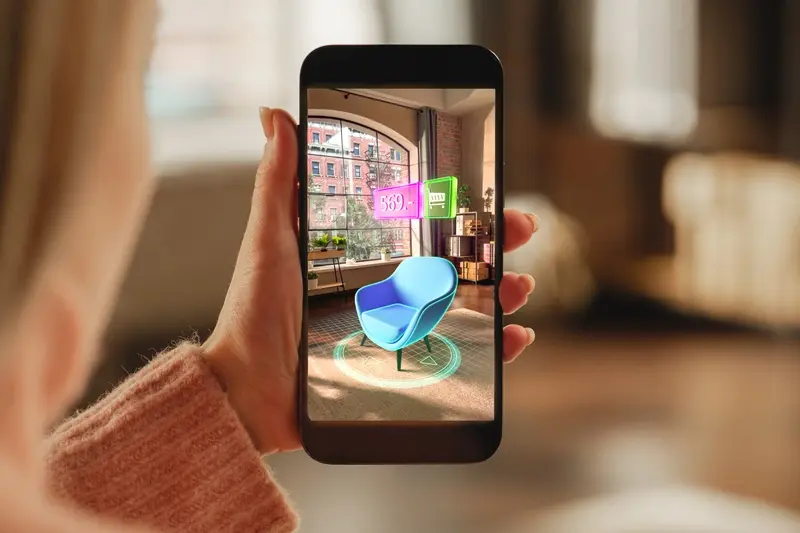
The depth sensors help these apps understand the floor plan and place virtual objects accurately on real surfaces, so that sofa actually sits on your floor rather than floating in mid-air or sinking through it. The better implementations also use the depth information to handle occlusion properly, which means if you walk in front of the virtual sofa, it appears behind you like it would if it was really there. This kind of realistic interaction relies completely on the phone understanding the three-dimensional layout of the space. However, creating these immersive experiences requires careful consideration of whether AR or VR technology best serves your specific use case.
- Open the shopping app and find the product you want to preview
- Tap the AR or 3D view option to activate the camera
- Point your phone at the floor or surface where you want to place the item
- The app scans the space for a few seconds to understand the layout
- Tap to place the virtual item and move around to see it from all angles
- Use pinch gestures to resize or rotate if the app allows it
Light Detection in Games and Entertainment
Games that use depth sensing can do things that weren't possible before, like having characters that hide behind your actual furniture or creating virtual levels that adapt to the shape and size of your real room. I've seen some clever implementations where the game uses the LiDAR data to generate obstacles and platforms based on the actual layout of your space, making each play session unique to your environment. The technical challenge is doing this in real-time whilst keeping the frame rate smooth enough for gameplay, which is where understanding what makes apps feel smooth becomes crucial for game developers.
Pretty demanding on the processor.
Entertainment apps also use depth information to create more immersive experiences, like concert apps that place virtual performers in your room or educational apps that bring historical scenes to life in your actual surroundings. The depth sensing helps maintain the illusion by ensuring virtual objects respect the boundaries of real ones... a virtual dinosaur will walk around your coffee table rather than through it, which makes the experience feel much more believable than older augmented reality that couldn't understand the physical space. Educational developers particularly benefit from cognitive learning principles when designing these interactive spatial experiences for children.
When developing games with depth sensing, test on multiple devices and in various lighting conditions, as sensor performance can vary significantly and affect the player experience.
Photography Apps That See Depth
Portrait mode on phone cameras relies heavily on depth sensing to separate the subject from the background and create that blurred background effect that used to require expensive camera lenses. The depth sensors provide a map showing which parts of the scene are close and which are far away, letting the camera app apply blur selectively to create a more professional-looking photo. This works much better than the older software-only approaches that tried to guess depth from a single image and often got the edges wrong.
Makes a real difference.
Beyond portrait mode, some photography apps use depth information to enable effects that weren't possible before, like relighting a photo after you've taken it by understanding the three-dimensional structure of the scene. We've built camera features that use depth data to measure objects in photos, apply effects that respect the geometry of the scene, and even create 3D photos that you can slightly move around by tilting your phone. The depth information adds a whole extra layer of data that creative apps can use in interesting ways, though it's important to consider whether aesthetic features enhance or hinder actual user engagement.
Privacy and Battery Life With Light Sensors
Using depth sensors does consume more battery than regular camera use, since you're running extra hardware and processing all that depth data in real-time. In the apps we build, we're careful about when to activate these sensors and when to rely on standard camera data, because nobody wants their battery draining in ten minutes. The power consumption varies depending on how frequently you're scanning and how much processing you're doing with the depth data (some operations are more demanding than others).
Worth thinking about.
Privacy is another consideration, though perhaps less of a concern than people initially worried about. The depth sensors can't see through walls or clothing, they just measure distances to visible surfaces in the same way your regular camera can see them. The depth data itself doesn't reveal anything your camera couldn't already capture, though apps do need permission to access these sensors just like they need camera permissions. We always recommend being transparent about what data you're collecting and why, which has become sort of standard practice now after all the changes to privacy regulations over recent years. Ongoing maintenance and updates for sensor-based features can present unique challenges, which is why some businesses find that certain developers struggle with complex app updates involving hardware integrations.
Depth sensing adds minimal privacy risk compared to regular cameras, as it only captures surface geometry of visible objects rather than detailed visual information.
Conclusion
Light detection technology has opened up new possibilities for mobile apps that understand and interact with the physical world around them. From practical tools that measure and scan spaces to entertainment apps that blend virtual content with real environments, depth sensing has become a capability that developers can build on to create experiences that just weren't possible a few years back. The technology keeps improving as more phones include better sensors and as we developers figure out more interesting ways to use them, which means we'll keep seeing new applications emerge.
The accuracy and reliability have reached a point where businesses can depend on these sensors for professional use cases, not just novelty features. We've worked with clients across industries who are finding genuine value in apps that leverage depth sensing, whether that's reducing returns in e-commerce, speeding up property surveys, or creating more engaging ways to visualise products and spaces. The phones people already carry now have capabilities that required specialist equipment not long ago, which creates opportunities for apps that solve real problems in new ways.
If you're considering building an app that uses light detection or any other mobile sensor technology, get in touch and we can talk through what's possible with your specific requirements.
Frequently Asked Questions
Most flagship phones from Apple (iPhone 12 Pro and later), Samsung (Galaxy S20+ and newer), and Google (Pixel 4 and later) include some form of depth sensing technology. Check your phone's camera specifications or look for features like "LiDAR scanner," "Time-of-Flight sensor," or "3D depth camera" in the technical specs. You can also test by trying apps with AR features - if virtual objects stay properly positioned on surfaces, you likely have depth sensing.
LiDAR sensors generally work well in dark conditions since they emit their own infrared light, but performance varies by sensor type and lighting. Structured light systems can struggle in bright outdoor sunlight, while LiDAR typically handles various lighting conditions better. Most sensors work best indoors or in moderate lighting conditions for optimal accuracy.
Modern phones with LiDAR can achieve accuracy within a few millimeters for typical room measurements, making them suitable for professional use cases like furniture placement or basic renovation planning. However, they're not quite as precise as dedicated laser measuring tools for critical construction work. The accuracy also depends on your technique - steady movements and proper distance from objects improve results.
Yes, depth sensing uses more battery than regular camera functions because it runs additional sensors and processes complex 3D data in real-time. Battery drain varies depending on how frequently the sensors scan and how much processing the app does with the depth data. Well-designed apps activate these sensors only when needed rather than running them continuously.
No, light detection sensors only measure distances to visible surfaces, just like your regular camera can see them - they cannot see through walls, clothing, or other solid objects. The depth data reveals the same information your camera already captures, just with distance measurements added. Apps still need camera permissions to access these sensors, and the privacy implications are similar to regular camera use.
App quality varies significantly based on how developers implement the depth sensing technology and how well they optimize for different sensor types. Some apps use multiple sensor approaches for better accuracy, while others may only work with specific sensors. The app's ability to handle different lighting conditions, processing efficiency, and sensor calibration all affect performance even on identical hardware.
The infrared light used by depth sensors is extremely low power and considered safe for normal use - it's similar to the infrared used in TV remote controls. The light levels are well below safety thresholds established for consumer devices. These sensors are designed for continuous operation and have passed regulatory safety testing before being included in consumer phones.
Yes, depth sensors work independently of your vision since they emit and detect their own light rather than relying on what you can see. Glasses typically don't interfere with sensor performance, though very thick or heavily tinted lenses might occasionally cause issues with some camera-based AR features. The sensors measure physical distances regardless of your personal vision capabilities.
Share this
Subscribe To Our Learning Centre
You May Also Like
These Related Guides
How Long Does It Take To Develop An AR Mobile App?
How Do I Track Exercise Data Accurately in My Fitness App?